Wednesday, October 2, 2013

Fall 2013: Beyond the Boundary

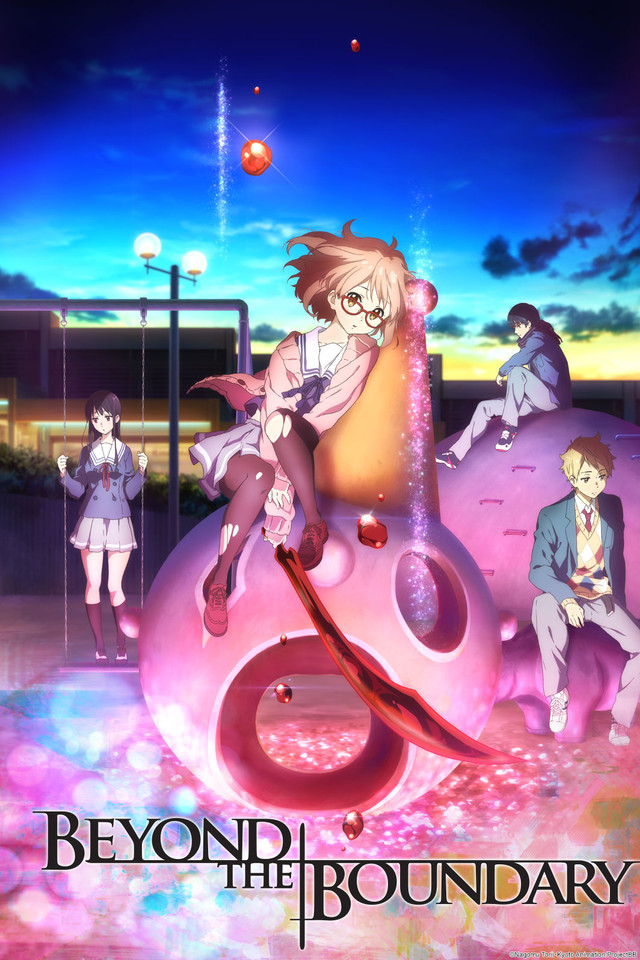
Akihito is an immortal and a half-youmu. And if that isn't generic enough, there's a (cute!) girl that's trying to kill him because he's half-youmu. Kuriyama, the girl is rather interesting, though. She fights with a sword made out of her own blood, which is kind of creative. The plot of everything else (of course) is that youmu inhabit the world and there are spirit warriors that fight against them.
Image source: http://www.crunchyroll.com/beyond-the-boundary
The setup, the description, and the promotional art that I've seen all seem really generic and I was not looking forward to watching Beyond the Boundary. But, after watching it, the execution of a good portion of things is actually pretty good. It's Kyoto Animation and, while I haven't seen them do action shows, their "action" animation in Free! was great and it continues to be pretty good here. But I think the best part about the show is the cues, which are pretty much spot on. Everything happens just as it should and the show doesn't feel rushed or like a drag.

That said, the dialogue in the show is super spot on. In the first narration, Akihito is trying to convince Kuriyama to not commit suicide (which, by the way, made me groan internally pretty loudly). The execution here was really poor and definitely the weak part of the show. And in a television show, your dialogue cannot be as bad as Beyond the Boundary has been thus far. There's lots of on-the-nose lines and, while the acting itself is alright, the scripts need work.

For now, I'll chalk it up to being a first episode and trying to get as much information out as possible. It doesn't make it any less poor, but I'll give it a pass for now and watch the next episode soon enough.

Rating: 2.5/5

Monday, September 16, 2013

Fall 2013: Diabolik Lovers

Diabolik Lovers (with a k instead of a c, because that's edgy) is the latest from ZEXCS, who did Flowers of Evil. Now, I loved Flowers of Evil's animation. It was brilliant. But this...I guess the animation is...of quality. It isn't so awful that I have to turn it off, but it isn't anything spectacular.
Image source: http://www.crunchyroll.com/diabolik-lovers
The show's premise is that church girl Yui Komori is moving into this giant mansion with a whole bunch of boys. In concept and execution, a lot like last season's Brothers Conflict. But while BroCon seemed to be a lot of pampering the main character, this one seems intent on abusing Yui. She was completely abused by the six brothers living in the house, one of which keeps calling her Bitch-chan.

Oh, and they're all vampires.

I think the only thing more repelling than this show is if Yui secretly wanted to be eaten or sexualized by the vampires. I wish I hadn't watched it, but I told myself to write my own preview guide. You know, for practice. And I typically watch all the first episodes anyway. But AVOID THIS LIKE THE PLAGUE. Unless it gets better, and it likely won't, you'll just be insulted.

It's merits include its character designs, which are nice albeit generic, and its run time. It's mercifully 14 minutes.

1/5

Saturday, August 24, 2013

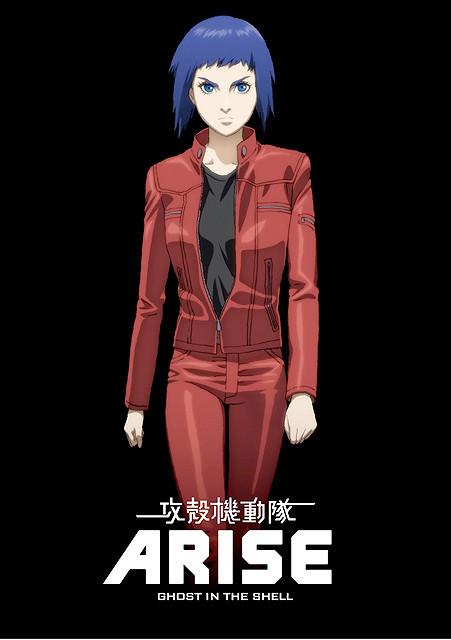
Ghost in the Shell Arise 1 review

When I first heard that some new Ghost in the Shell was being announced, I threw my hands up in the air in celebration. Ghost in the Shell is one of my favorite anime helmed by two of my favorite directors (Mamoru Oshii and Kenji Kamiyama). A new director’s spin on things is going to be awesome! As I heard more coming down the pipeline, like that it was a completely separate timeline from either Oshii’s or Kamiyama’s, I got a little more excited and when I heard that it was going to be a prequel, I got a little less excited. But all that aside, Ghost in the Shell Arise certainly delivers on every level I’d have wanted it to out of a first episode. 

Ghost in the Shell Arise is a prequel to Shirow Masamune’s original Ghost in the Shell comics. However, I don’t believe that it is stand alone. Everything would feel so distant without any introduction to the series (whether that be Masamune’s comics, Oshii’s films, or Kamiyama’s series). But don’t let that be a detraction from an otherwise great work.

Production I.G puts in their A-game in terms of animation here. It blends a modern-style of character designs (done by Kazuchika Kise, who worked on xxxHolic and Legend of the Galactic Heroes of all things) with Oshii’s original feel of the films (a bleaker, dirtier cyberpunk vision compared with Kamiyama’s sleeker look). Kise’s also directing these OAVs and he certainly proves that he can do it. He’s previously worked extensively as a key animator and an animation director, but this is his first time in charge. The direction isn’t bad, but it’s nothing outstanding either. The action scenes were really cool, but they weren’t nearly as dynamic as Oshii’s films.

The scripts are helmed by Tow Ubukata, a longtime contributor for Production I.G (he worked on Le Chevalier D’Eon, Heroic Age, and Mardock Scramble). The scripts are much better than Kamiyama’s as they feature much less stilted dialogue and everything flows much nicer. I’m not sure what Kamiyama was doing in Ghost in the Shell, because his Moribito and Eden of the East scripts were fine.

The music was pretty cool in here too. It’s hard to follow after Kenji Kawai and Yoko Kanno, but Cornelius does a stunning job. It’s nothing I’d listen to recreationally (and I’d listen to Kawai and Kanno’s stuff ad infinitum), but it really fits the mood of the series. The opening in particular provides a great door to the rest of the series. This is the PV, but the opening plays in it.
Arise begins with the familiar Major, now noticeably younger, returning to Japan after a stint somewhere (it’s not brought up, nor is it of particular importance). Still a little wet behind the ears compared to what Oshii or Kamiyama’s versions portrayed, she’s in Unit 501 and her commanding officer has just died.

The things she fights in the first scene we see her in are reminiscent of the dolls from Ghost in the Shell: Innocence, but they’re anything but. They’re actually walking mines that’ll explode upon a good gunshot to the anywhere. The doll thing is actually inside of the coffin that’s supposedly holding Kusanagi’s commanding officer’s body (and intact cyberbrain).

What the show fails to do immediately is inundate us with a familiarity with the characters, which is why I wouldn’t suggest these OAVs to a Ghost in the Shell newcomer. I’ve seen Oshii’s films and Kamiyama’s series (but not Masamune’s original comics), so I’m quite familiar with the Major and her typical antics. In Arise, she’s noticeably different. She acts a little more rashly and she’s a little shorter tempered (and she wears more clothes).

What the show succeeds in is what Ghost in the Shell has always succeeded in: Creating an interesting world with an interesting story involving political intrigue. These OAVs are revolving around the aftermath of the last World War, in which Japan threw seemingly all their money into cybernetics research. Now that the war is over, they have to find a new purpose for people like Kusanagi, who are fully cybernetic. It also poses a problem that never existed in the previous anime adaptations: Kusanagi’s body is technically the property of the army, not her own. In addition, the army is considering implementing a rule for people with full cybernetic bodies similar to a labeling system. They would have to register their body and get approval for basically any action they take. Kusanagi, of course, is against it.

But that’s a very interesting concept that hasn’t really been brought up prior. There’s been a blur between what’s human and what’s cyborg—the first Ghost in the Shell film was about that. But there’s never been anything dealing with prejudice against fully cybernetic bodies or any desire to control those with them. Since Ghost in the Shell’s concepts and stories have been so intriguing, I haven’t considered it, but now that it’s brought up, there’s been a missed opportunity until now.

The bulk of the story, though, is trying to find out how and why Kusanagi’s superior officer, Lieutenant Colonel Mamuro died. In this process, Kusanagi finds something happens to her that happened to a random garbage man in the first film: Her memory is altered. Kusanagi’s memory is, mercifully, fixed. But until then, she’s seeing things she shouldn’t be and not seeing things she should be. It’s not until the third act when she syncs her vision with the Logicoma that she sees things as they truly are.

From beginning to end, we get drops of people from the franchise, most prominently thus far is just Aramaki. Batou (still a Ranger at this point), Pazu, and Togusa (still a police officer) make their small appearances. While they’re important to the plot, they don’t serve much purpose as characters. Its obvious Ubukata is working in their pasts into Kusanagi’s just so they can meet up, but with a prequel story, it’s bound to happen. It isn’t done awkwardly and everyone gets their fair amount of screen time. However, these OAVs are about Kusanagi and not much spotlight should be placed on anyone else.

The cast is completely replaced on the Japanese side of things. Maaya Sakamoto (the only “returning” cast member) plays Kusanagi, a role she once did in Oshii’s film and the Laughing Man OAV as a young Motoko. Kenichirou Matsuda, Batou’s actor, hasn’t done much, but he’s tackling this big character well enough. In comparison, Tarusuke Shingaki as Togusa has much more under his belt, most notably Kariya Mato in Fate/Zero. One of the stand outs is Ikkyuu Juku as Shinji Aramaki who, again, hasn’t done much else. But THE stand out is Miyuki Sawashiro as the Logicoma and don’t let anyone else tell you otherwise. She brings her usual charm into a mix of veterans and newcomers and fits the Logicoma perfectly to the Tachikoma.


The OAVs promise more than they give thus far, and the ending is of course going to be the formation of Section 9 as we know it in other anime media. It looks like the mystery behind Lieutenant Colonel Mamuro isn’t fully solved yet and Kusanagi is still on the fence about joining up with Aramaki. Or at least, that’s what she wants Aramaki to think. Internally, she sounds excited for the opportunity, and so am I.

Sunday, August 4, 2013

Barefoot Gen review

I’ve been striving to write more reviews for my blog, just to get my own words out there. Now, I’ve had five beers, but throughout the film I’ve been drinking water and I’m pretty much out of the proverbial woods of inebriation now.

Recently, I’ve had a lot on my plate and not enough time to do it. Reviewing anime and manga part time is becoming too full time and it’s only my own fault for that! But I’m glad to be doing it, because I like doing it. But for today, I’m reviewing Barefoot Gen from back in 1983 and 1986. 

There’s something insatiably interesting to me about media from a country that lost a war. In the 50s, America got a lot of comedy out of its entertainment media because we didn’t want to think about what we just went through (not that Americans went through more than Japan, but both countries gave up a lot). But Japan comes from a very interesting perspective. Japan is the country that lost the war—in fact, Japan surrendered unconditionally. Germany and Italy are the other two big powers that lost the war, but I don’t think they’ve created nearly as much entertainment media as Japan has over the years and certainly not as much about the war as Japan did.

Japan’s creators were influenced by the calamity they went through, moreso than Germany and Italy or any of the Axis powers. People like Akiyuki Nosaka, Keiji Nakazawa, and Shigeru Mizuki were so profoundly affected by the war and the post-war aftermath that they couldn’t help but write about it. And I couldn’t be more glad they did.

Grave of the Fireflies is the other well-known anime film about post-war Japan. Grave of the Fireflies follows Seita and Setsuko as they simply attempt to survive after their parents are killed. It’s about survival more than anything else.

While Barefoot Gen is undoubtedly about survival, it also takes a deep and dark look into what exactly an atomic bomb does to the people it hits. Having not lived in the era, never been through war, and been as detached for hardship as I almost possibly could be, the experience of simply watching it play out had a profound effect on me.
-----
I kind of went off the rails for a few days, and while these previous paragraphs were written Friday night, it is now Sunday afternoon and I have forgotten the flow I was in during the sleepless stupor at 3 in the morning Friday (technically Saturday). Let’s continue. 

Barefoot Gen doesn’t attempt to romanticize war, as we in the US often do in our film media. It doesn’t try to tell a sob story about the war-torn Japan. It tries to depict life as it was in the aftermath of Hiroshima/Nagasaki. Not only this, it achieves something more. The Japanese are a proud people and when Japan didn’t surrender, the film depicts the people not directly affected by the bomb praising this decision (and even some affected by the bomb praising it). They didn’t want to “conditionally surrender.” They wanted to continue fighting as a country that had already lost its way and the war. Its people were suffering, but TWO atomic bombs had to stop it. That’s part of this depiction, of Japanese nationalism and loyalty. Some Japanese were ashamed, even after Hiroshima and Nagasaki, that Japan surrendered. They can’t be seen surrendering, they need to be annihilated honorably (just read Mizuki’s Onward Towards Our Noble Deaths for that depiction). But Gen, his father, and his family all agreed that if you discard honor for the sake of the life of people, it would be worth it.

That kind of selflessness is a running theme throughout the film. When they meet a burn victim later, Gen licks the burns and says, “These aren’t dirty at all.” These same burns that she’s been ridiculed about since she received them, Gen was embracing and accepting. It’s these kinds of acts that make the film so indelible.

But the film is about tragedy, and tragedy strikes Gen more than just Hiroshima. His sister is born in the ashes of the bomb, and his mother and he struggle to provide sufficient nourishment to her. Everything finally seems alright when Gen and newfound orphan and “brother,” Ryuta Kondo, care for a rich man’s brother, badly burned from the bomb. They received 100 yen and use it all to buy milk. But when they get home, they find that Gen’s sister has already died from malnourishment. These depictions of the war are what emphasize not just the immediate aftermath, but the aftermath days and months after the bomb hit. No one in Hiroshima or Nagasaki was able to recover except the rich, and everyone else was pushed to the lower class and given rations of rice porridge they were happy to have.

The one ray of hope Gen and Ryuta have is the wheat that’s starting to grow despite the fact that grass isn’t supposed to grow for 70 years after the bomb.

The second film picks up three years after the first, and features the aforementioned burn victim girl. The aftermath is only emphasized with the poisoned rain and lingering radiation sickness.

A striking part is the anti-American sentiment that the Japanese had after the bombings. This is, of course, to be expected after something like an atomic bomb, but it’s not something you immediately think of when you consider everything that surrounded Hiroshima/Nagasaki. The adults would look at their occupiers with scorn and wonder why they even needed to be there. Schools would teach, monotone, the rules of Japan’s unconditional surrender. And while the Americans likely got all the resources they needed, Japan’s struggling middle and lower classes were still starving.

Of course, the film can’t be complete without another tragedy. Gen’s mother, suffering from her own malnutrition and cancer, ends up succumbing to it all. Gen is now without any family left, and is kind of listless for a while. It’s only his orphan friends that allow him to grip reality again and continue on living.


These two films are some of the best depictions of a war-torn country I’ve ever seen, and one of the best World War II films I’ve ever seen. They’re also among the paramount anime of the 1980s. They’re a must-see for any anime fan interested in good cinema.

Sunday, July 28, 2013

Rurouni Kenshin film review

Here at AnimeIowa, or at anime conventions in general, you can usually check out some really cool things in the video rooms. In my case, I missed out of Golgo 13 and Evangelion 3.0, but I did check out that Rurouni Kenshin live action film from back in 2012.


I didn’t expect much of this from what I’d heard—I saw the trailer and thought it looked pretty cool, but you can’t garner much from a trailer. What I mostly got out of it was a pretty exciting film with good visuals for what it was trying to do.

Kenshin fit in every major character from the anime in some way (except Misao), and it’s a good thing the film didn’t try to do too much with them. Characters like Yahiko and Sanosuke are merely there as nods to fans and don’t serve much of a purpose beyond that.

Fans of the original manga and anime will recognize one of the main villains as the antagonist for the first arc in Kenshin (the one with the “Battosai” claiming to be part of the Kamiya dojo). Parts of this story are taken out, such as why he’s trying to taint the Kamiya dojo’s name, but it doesn’t take away from the film as a whole. Fans know why and those coming in new will enjoy him for what he needs to be: a challenge for Kenshin in terms of swordplay.

But otherwise the villain falls kind of flat. He's seemingly just there to provide a challenge to Kenshin and as a bodyguard to the other main antagonist. He is an opium dealer that I vaguely recognize from the series, but I don’t remember his name…After looking it up, it’s Takeda Kanryu. But anyway, his character works as well. He’s the money-grubbing dealer that takes advantage of the drug’s most sellable quality, its addictiveness.

See a trend so far? The minor characterizations are pretty much fine, and often downright entertaining, but no one’s really growing or being more than a one-dimensional and sometimes two-dimensional characters. It’s the same for Kaoru, arguably the second most important character after Kenshin. Her role is largely the voice of reason for Kenshin.

But the film does revolve around Kenshin and, despite how subtle and sometimes frustrating his arc is in the film, he does have an arc. His internal conflict between himself has always been keeping to his now-semi-pacific philosophy and reverting to his Battosai persona. Throughout most of the film, he maintains his aloof and cool personality. Each and every event challenges Kenshin to maintain that persona and each and every event pushes him further over the edge until he compels himself with a mantra. “I will kill you to save Kaoru.” He’s not saying that to Jin’e, the man who was sullying the Kamiya dojo, he’s saying that to himself. He’s justifying his actions to kill this man to save Kaoru’s.

It really felt like this movie was one of those where you go ask yourself, “What is this movie doing?” throughout the entire film and you finally get that “A-HA!” moment near the end when you see Kenshin’s transformation in full (a change in voice and demeanor like in the anime).

The best parts of the film are in what it doesn’t do. The comedy isn’t over the top, like the anime sometimes was, and the battles are kept mostly realistic. I really appreciated the lack of Power Rangers-esque wire pully systems just to maintain that anime feel. Of course, they were still in there, but it was only during the climactic battle, so I give it a pass.

The story of the film is rather convoluted. Because of the introduction of so many characters, trying to do enough justice to be a nod to fans but not be intrusive, some of the story is sacrificed. Overall, it's of course about the opium dealer and how he just happens to correlate with Kenshin. But its disjointed by Sano trying to challenge the Battosai to prove his worth, distracted by the incident with Jin'e taking too long to resolve. If the script had been plotted tighter, the film would be much stronger and much more accessible to fans wanting to get into it new.

What I wanted out of the film was a reminder of why I liked the original anime back when I watched it in the early 2000s, and I got that in full force. It’s not great for someone new to Kenshin, but it’s really fun for someone at least vaguely familiar with its source material.

Grade: B+

Wednesday, July 10, 2013

All about pre-1997ish anime

Like I usually do, I ranted on reddit a lot yesterday. Except this time, it was suggesting a lot of classic anime to some dude who wanted classic anime suggestions. Since I couldn't just let that fall into the aether of reddit, like everything does, I wanted to post it here. And since I have no pretense of professionalism, it's fine with me. Even if I did have a pretense of professionalism, it's since gone from my old and poorly written posts.

Without further ado:


I've been down this road myself, and I've found quite a few anime that are worth watching, or are in my queue to watch. Revolutionary Girl Utena flies under your radar, since you said pre-1995. But it's one of the seminal titles of the 90s.

Armored Trooper Votoms was a compelling and complex story about politics and robots that can't fly. That's right, they can only slide really fast with their wheel things.

Galaxy Express 999 and its sequel Adieu Galaxy Express 999, I've been told, are among the best space opera shows of the 70s and 80s. The series is streaming on Crunchyroll. All glorious 113 episodes of it (I call it glorious because I've heard it is).

A bit of an obscure one (but just because us in the west didn't get much into sports anime) is Aim for the Ace. If you've heard of Osamu Dezaki, he helmed the series about a girl playing tennis. It's never going to be licensed, so I torrented it and that's going to be the only way to get it.

Speaking of Dezaki, he's got quite a few things worth checking out. First off, the Black Jack OVAs from 1993. I'll basically give anything that has Tezuka's name on it somewhere a look. Unrelated, Anime Sols is streaming the 2004series. I watched the first episode and threw money at Anime Sols like a parent buying Christmas gifts.

The aforementioned Rose of Versailles was also helmed by Dezaki. He took over in episode 19, according to Anime News Network.

The third, and only, Dezaki work I've watched myself is the Space Adventure Cobra film and I couldn't recommend it highly enough. If any film represented anime in the 1980s, it is probably Space Adventure Cobra.

And I can't believe no one's mentioned Legend of the Galactic Heroes yet! Do I need to explain this one? Because I haven't seen it yet and honestly can't.

For the ridiculousnes, you must do Fist of the North Star. When Right Stuf had their Discotek sale, I didn't pick it up. I regret it to this day and definitely will during their next Discotek sale or when I want to.

The Ghibli's you definitely need to see (if you haven't yet; you didn't list them at least) are: Nausicaa of the Valley of the Wind (not technically Ghibli, shut up), Castle in the Sky, Kiki's Delivery Service, and My Neighbor Totoro.

I'll reiterate Mobile Suit Gundam and vouch for the film trilogy, which ends with Char's Counterattack. The film is technically a follow up to the Zeta Gundam and Double Zeta series, but I had no problem understanding what went on without slogging through all that Zeta.

I'll also add the OTHER mecha show of the decade, Macross: Do You Remember Love?. Campy songs aside, it is a great film worth looking at for any anime anthropologist.

Moving on to the early 90s, check out Memories if you haven't. It's another one by Katsuhiro Otomo and features early works of Satoshi Kon, Tensai Okamura, and Yoko Kanno.

Speaking of Satoshi Kon, again falling under (or over?) your wire is Perfect Blue. A 1997 film that started his career and he, in my opinion, never made anything better. Not to say that I didn't absolutely love Tokyo Godfathers, Millennium Actress, and Paprika. But Perfect Blue was the pinnacle.

More Macross in the 90s (because it's fucking Macross) is Macross Plus featuring some guy named Bryan Cranston. I hear he's in some bullshit nowadays.

I'm counting it because I'm a total cheater, but The Vision of Escaflowne has got only praise from those I've heard from. I watched a few episodes about 5 years ago and wasn't impressed, but I'm going to have to go back. It's 1996, which is why I say I'm a cheater.

Neon Genesis Evangelion if you haven't watched that for some reason.

Last but not least is Touch. I said we were out of the 80s, but I LIED. I lied to your face and I have no regrets about it because Touch is perhaps my favorite series that I've listed thus far (Utena may beat it out though; I'm halfway through Utena). Touch is a baseball anime that is so endearing and so (haha) touching that you can't help but put on the next episode when you finish one.

Oh, by the way, anime may be referred to as going through a golden age in the 1980s because that was around the bubble for anime in Japan when money was freely flowing and OVAs were pushed out like hotcakes. Most sucked, but some were awesome.

By the way, I cannot recommend highly enough the Mamoru Oshii film Patlabor 2, which I forgot about since someone else mentioned it. That movie was so precedent to Japanese audiences that when the Sarin gas attacks hit Tokyo, the news outlets interviewed Mamoru Oshii. And yes, I totally stole that quote from ANNCast. 

Thursday, July 4, 2013

Honey and Clover

I just finished Honey and Clover for the second time, the first time was about a year ago. This is a show that you immerse yourself in and just allow yourself to make parallels with the lives of these characters, and it’s especially pertinent if you’ve just graduated college (which I have).

If you haven’t seen Honey and Clover yet, then WARNING, spoilers ahead.


While the first season of Honey and Clover is much about discovery, both of yourself and your new peers, the second season is more about reconciliation. It nicely wraps up the arcs of the story without seeming too convoluted. I’ll get more into that later.

First, I want to focus on a few of my favorite characters: Takemoto and Yamada. It’s easy for anyone to pick out a favorite character, because at least one of the six main characters (and four supporting cast) will resonate with you. For me, it was Takemoto and Yamada, both of whom are going through much the same journey I am right now.

Takemoto is undoubtedly the main character of the story. He’s the focal point of the first episode, he has the longest arc, and he’s the focal point of the last episode. And he’s definitely the best main character for this story because his life is a journey from his second year of high school up until graduation as a fifth year. His journey is also the most blatant to the audience. He rides his bicycle from Tokyo to Hokkaido and, while he doesn’t call this journey one of “finding himself,” he certainly does find himself throughout it. His approximately 1,000 km (630 mile) travel takes him all over Japan, to places he never even dreamed of going. Through this, he discovered exactly what he needed to discover: How important those things are that you left behind. Takemoto realizes that, no matter how far you run away, those people will still be there waiting for you when you come back. This is further emphasized with the part-time manual laborers that he meets along the way, who welcomed him back with open arms after knowing each other for just under two weeks.

It’s Takemoto’s return to Hanamoto-sensei, Mayama, Yamada, Morita, and Hagu that make his journey all the more impactful. In a callback to some episodes back, they go to a festival again at the end of the first season. In it, Takemoto, Yamada, and Hagu all act like the immature people they sometimes are (and aren’t we all?). But when it comes time to act the big man, Mayama gives Takemoto the money to pay for the festival games to act the big man, instead of taking the reins himself or having someone like the adult-figure Nomiya do it like in the first festival. This is the literal handing off of the torch to Takemoto from Mayama that signifies that, through Takemoto’s journey, the two are now peers instead of kohai-sempai as they have been.

Takemoto’s arc rings especially true for me because I’m at that stage where he was at near the end of season one, where he doesn’t really know what he wants to do with his life and he just keeps going to school and getting denied for jobs. I think most of us have gone through that stage of our lives where we’ve just graduated and we’re at a loss of what to do since we’re now just thrust into the real world.

It wasn’t until later in the series (because I was looking too closely on a character-to-character basis) that Morita is very much a foil to Takemoto. While Takemoto is kind of a wandering soul, wondering what he’s going to do. Honey and Clover relies heavily on internal monologues at the beginnings and ends of episodes and scenes, and during one of those monologues, Takemoto says that he entered art school because he liked to build things with his hands. That’s the case for so many of us, that we just enter college because we like to do X so we major in X. But Morita seems to have his life in order, even though he seems the most out of order in the group. He’s constantly getting art commissions, leaving for weeks or months at a time as a result, and he’s firmly set in the sculpture department. Morita seems to know exactly what he wants to do, but part of that is because he’s being sort of manipulated by his brother Kaoru. But the point is that Morita, this man with natural talent and jobs ahead of him, seems the least composed while Takemoto, struggling to even get hired for a job, seems the most composed (aside from Hanamoto-sensei and Mayama).

Morita provides his own foil to Hagu as well. Both are tremendously talented, and both are naturally so. What differs is that Morita seems uninterested in using his talents for anything unless it’s one of the commissions that Kaoru sets up for him. Hagu, meanwhile, simply wants to paint. There’s an amazing scene early on when Hanamoto-sensei visits Hagu at her home when she’s in high school. In the scene, Hanamoto-sensei sees all of Hagu’s drawings of the same exact scene, throughout the seasons. This wasn’t an artistic choice on Hagu’s part to show the changing seasons. No, this was the only thing Hagu could draw that was of nature. There was nowhere for her to go, because she was so trapped in her own world by her grandmother. But even after leaving for Tokyo and going to art school, she just wants to return home and be able to paint every day. She doesn’t have to make money or feel accomplished, she just wants to paint.

There’s something really indelible about Hagu’s character in that way. She’s not like Takemoto, who just wants to find his way in life. She’s not like Morita, who wants to be able to have fun with his contemporaries. She’s not like Mayama, who wants to be able to support the one he loves. She’s not like Yamada, who is too focused on Mayama to realize her full potential (more on Yamada later). And she’s not like Hanamoto-sensei, who wants to nurture young artists into professionals. Hagu, despite her loli character and usually distracting character designs, is simply a woman who’s been emotionally stunted due to the situations surrounding her and an artist that just wants to create art.

But it’s the natural talented-ness that draws Morita to Hagu, and Hagu to Morita. And it’s unfortunately what ousts Takemoto from both of them. However, it’s Takemoto and Hanamoto-sensei—perhaps the two least naturally talented in the group—that Hagu finds herself confiding in. There’s an episode where Hagu is alone because Hanamoto-sensei is out on a research trip and Yamada has to take care of matters back home. Takemoto comes over, worried about Hagu, and finds himself staying the night. It’s sweet and emotional to see these two, Hagu simply wanting comfort and not knowing how much she’s hurting Takemoto by that little thing and Takemoto wanting only to stay by the side of the girl he loves, but always at arm’s length. It’s a tender moment that epitomizes the love in the series.

It is perhaps Mayama that most emphasizes the love in the series. He’s the object of Yamada’s affection and when she confesses to him, over and over again, he can only say, “Yeah” to her, over and over again. He doesn’t want to close her off, but he doesn’t want to say yes. It’s unnaturally cruel, but weirdly nice of Mayama to hang Yamada out on a limb like this, barely holding on to the love she has yet already beginning to fall. Mayama keeps Yamada at this distance because he loves Rika, Hanamoto-sensei’s classmate and roommate in college.

Rika’s story is only one of tragedy, where she’s ousted herself from her classmates and only warms up to others when she start to hang out with Hanamoto-sensei and her eventual husband, Harada. Rika represents the spiral you can fall down, even after being so successful after college. Harada dies and she wants only to follow after him. It’s Hanamoto-sensei, ever the nurturer, that snaps her back into reality. Once Rika feels like she’s accomplished all she can, and nearly gives up on her life again, it’s Mayama that snaps her back again. Rika believes that she only has to wrap up the loose ends of when Harada was alive and then she can follow after him. Mayama, however, has fallen in love with her (at some points stalking her, though not maliciously). It’s Rika who holds Mayama at arm’s length this time, though. But it’s only their story that ends in happy love—or appears to end in happy love. Yamada is left alone, Hagu chooses Hanamoto-sensei so she can recover, Morita moves to LA to work with Peter Lucas, and Takemoto moves to become a restorer.

This, I believe, so encompasses the college life, though. The second season didn’t just reconcile everything, as I said previously. The second season makes you watch as these characters gradually grow apart. Morita just suddenly disappears, Mayama goes on a business trip with Rika to Spain, and Takemoto has finally found his place in life. This is much more representative of life, though. It’s not like everyone’s lives wraps up nicely all the time. Some people take five years to graduate, some people take eight, and some people go to graduate school. But everyone takes diverging paths at different times, especially in college.

Moving back to Yamada…It was her arc that I sympathized the most with. I connected the most with Takemoto, but watching Yamada hurt my heart every time she was on screen. It’s like watching an alcoholic drive him/herself further and further down the rabbit hole. But with Yamada, her alcohol is her love to Mayama.

What makes her story so endearing is that she’s so devoted to her love to Mayama, even when she knows that he’s not going to give her the time of day. Throughout the first season, it’s much the same thing. It climaxes with her dressing herself up in a kimono to watch fireworks, just to have Mayama compliment her on her looks. All that work for one comment and a promise of nothing. That so encompasses her love to Mayama, because he’s only willing to give Yamada that one line. Anything more would be to committing to Mayama and it would only hurt Yamada more. But, in fact, it’s the fact that he’s leaving her hanging at the edge that hurts the most.

The second arc, so to speak, of her love begins when Nomiya is introduced. Nomiya almost makes Yamada’s arc more hurtful to herself because there’s now this guy that does like her, but she denies her. As she says, if she starts to love Nomiya, won’t that just deny her ever loving Mayama? It’s not true that it’ll deny her previous love, but I see where she’s coming from. She never got any confirmation, or any kind of affection besides that of friendship, from Mayama. Only a tender, “Yeah” whenever she tried to confess her feelings.

Honey and Clover is on the level of such josei manga like Nana and Usagi Drop in its realistic storytelling. I never once felt like these were caricatures or characters in a story. I believed that these were real people going through real problems, and that’s an issue with a lot of the middle-of-the-road anime and manga out there (and, really, a lot of the middle-of-the-road media out there). The comedy elements are hit or miss on whether I laugh at them or not, but they’re rarely misplaced. The drama is realistic and makes you care for these characters. Each of their arcs are touching in different ways, and you’ll root for both Yamada and Mayama to find their own happiness by the end.


This is a series that hits very close to home for me right now, and I hope to be able to pop this in and remember the olden days as I grow older. As the show says, we will always have the memories of those days.